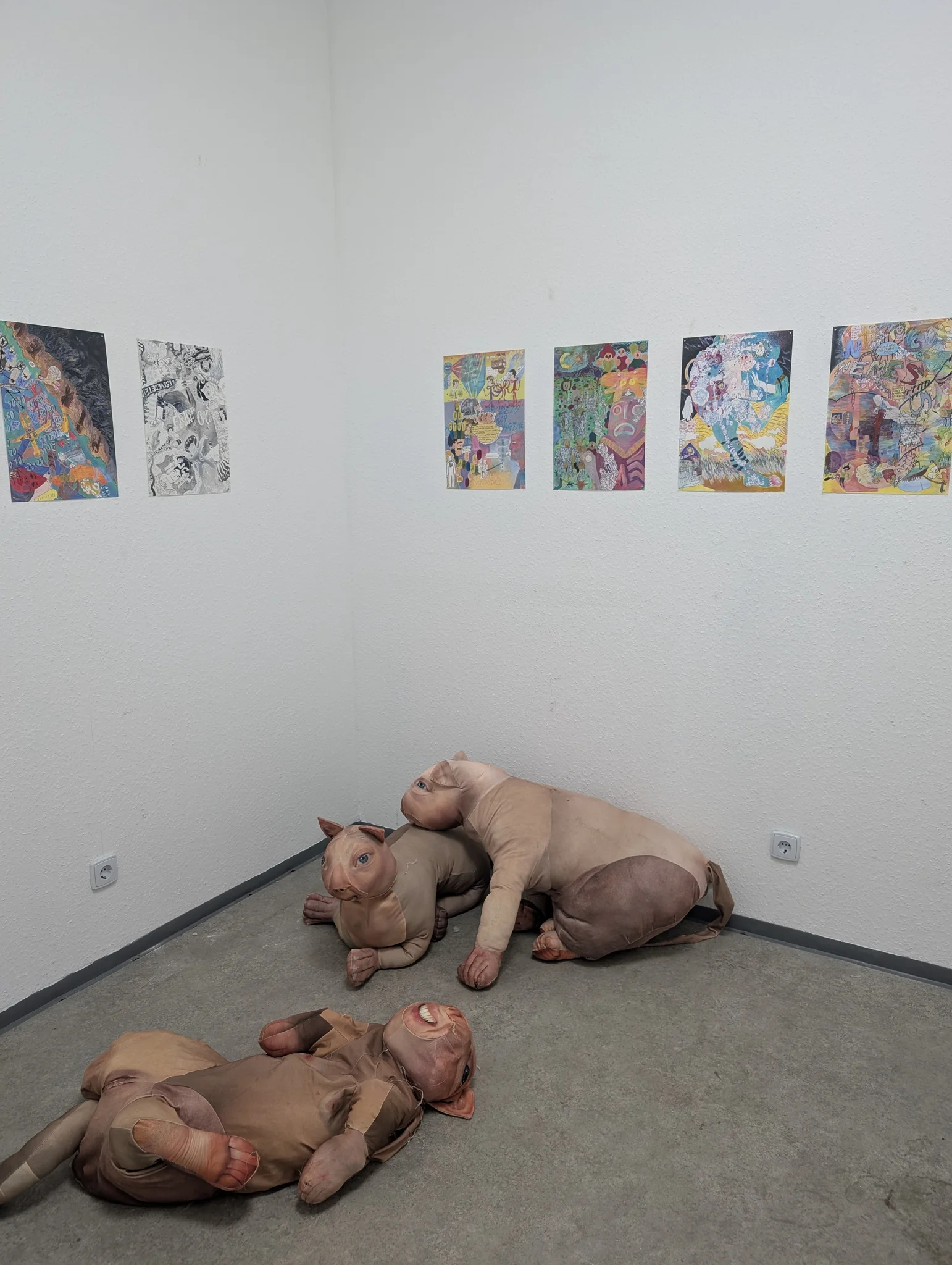
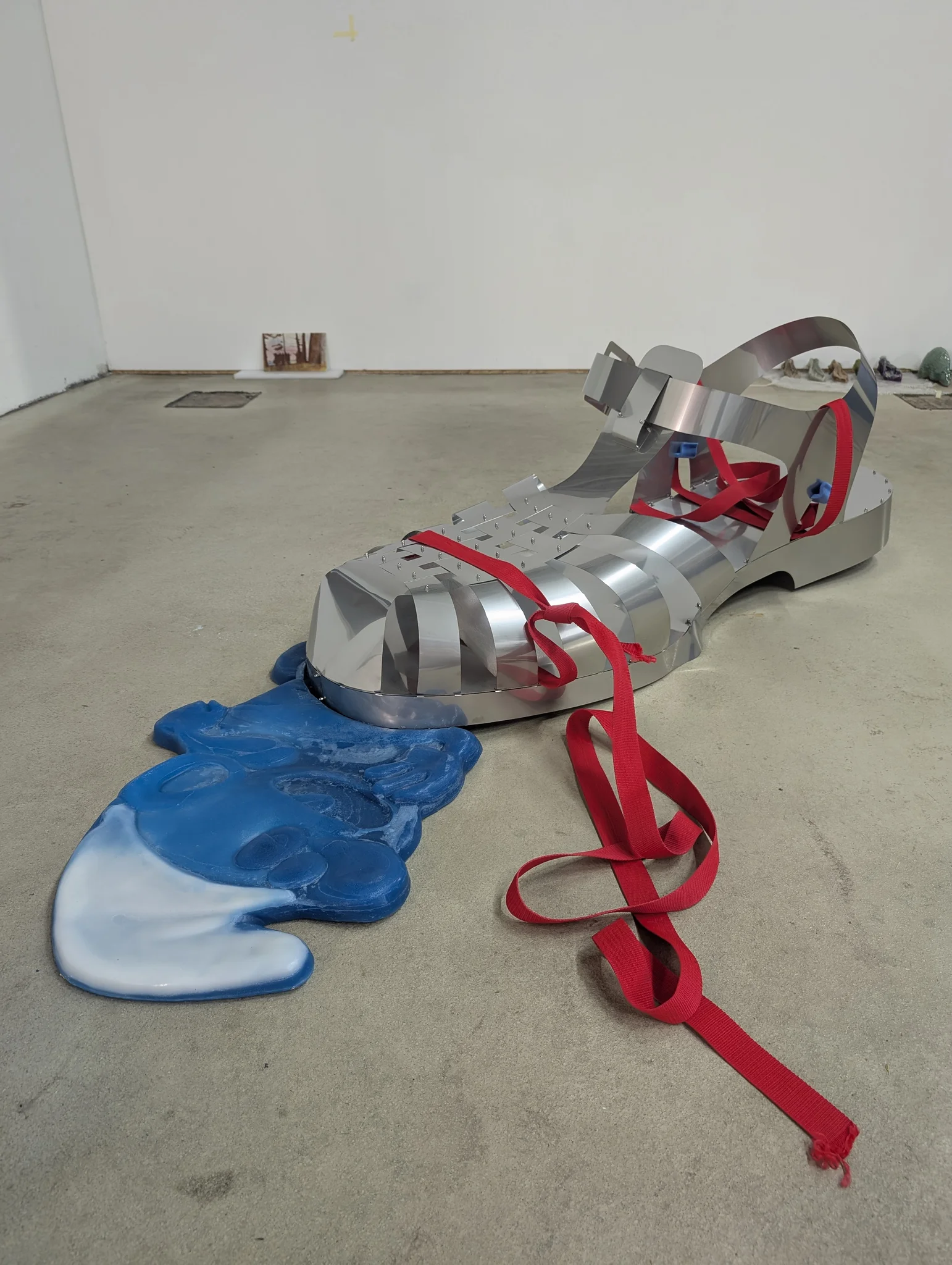
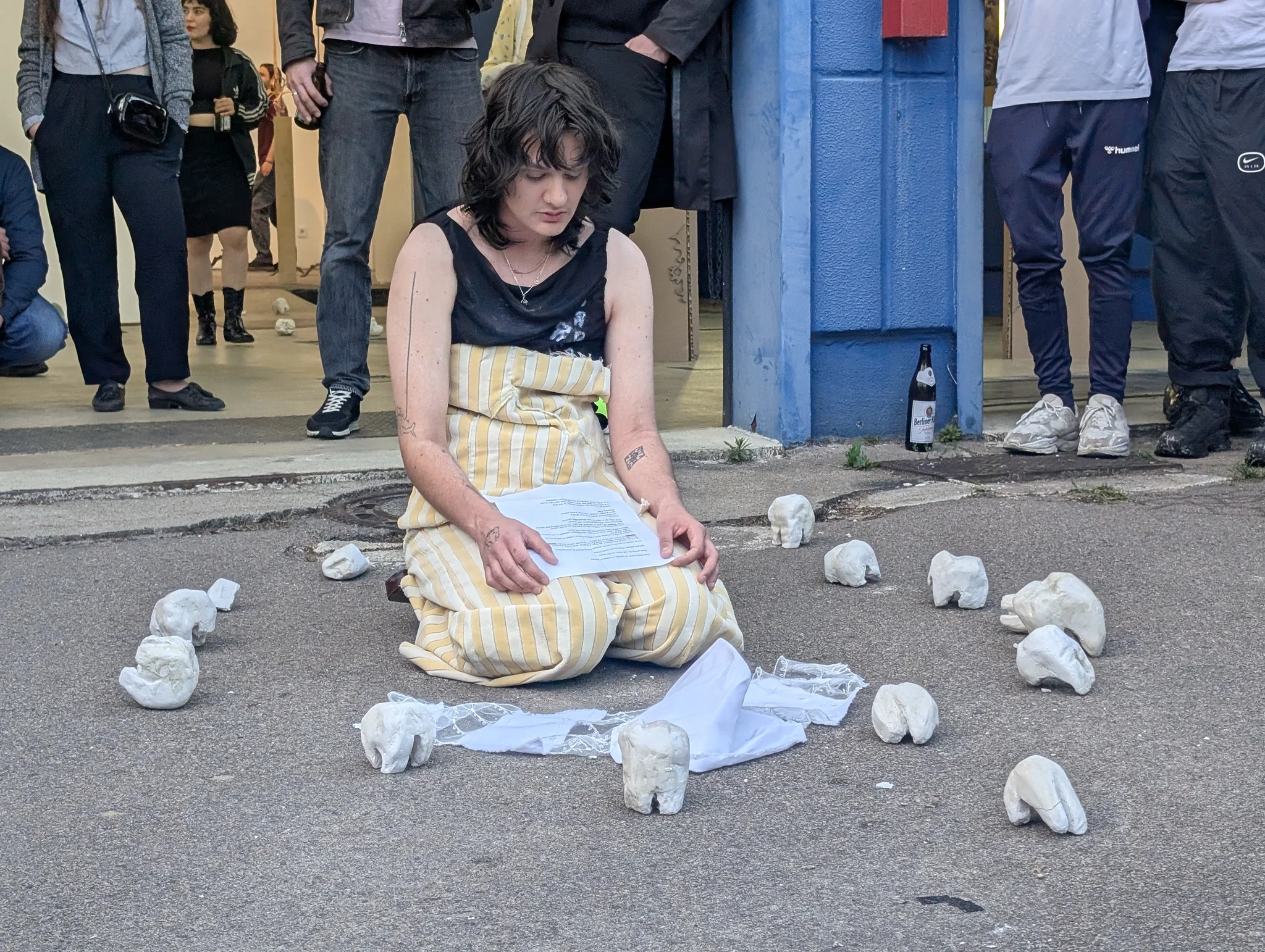
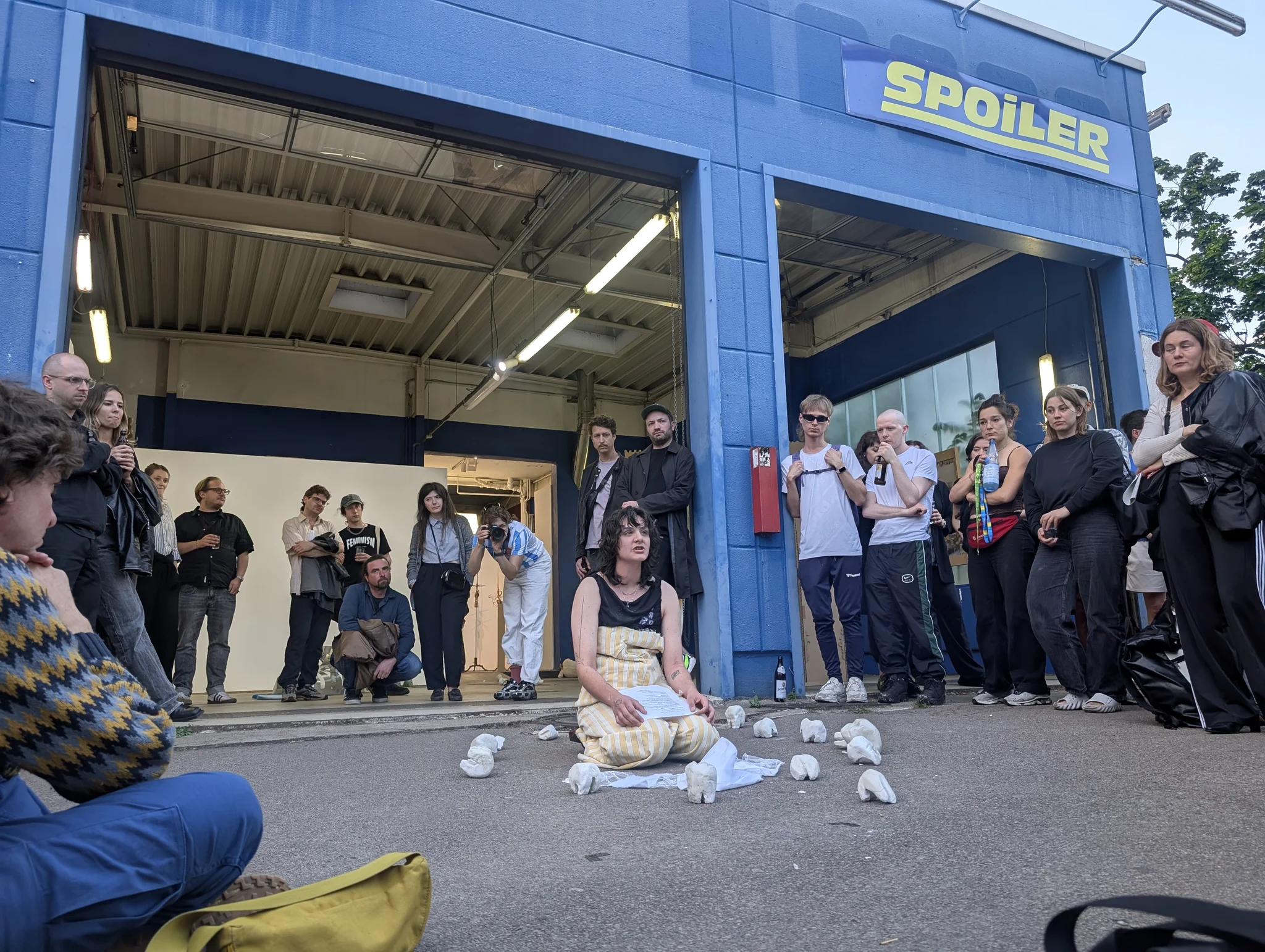
Spoiler Zone, Berlin, DE
------------------------
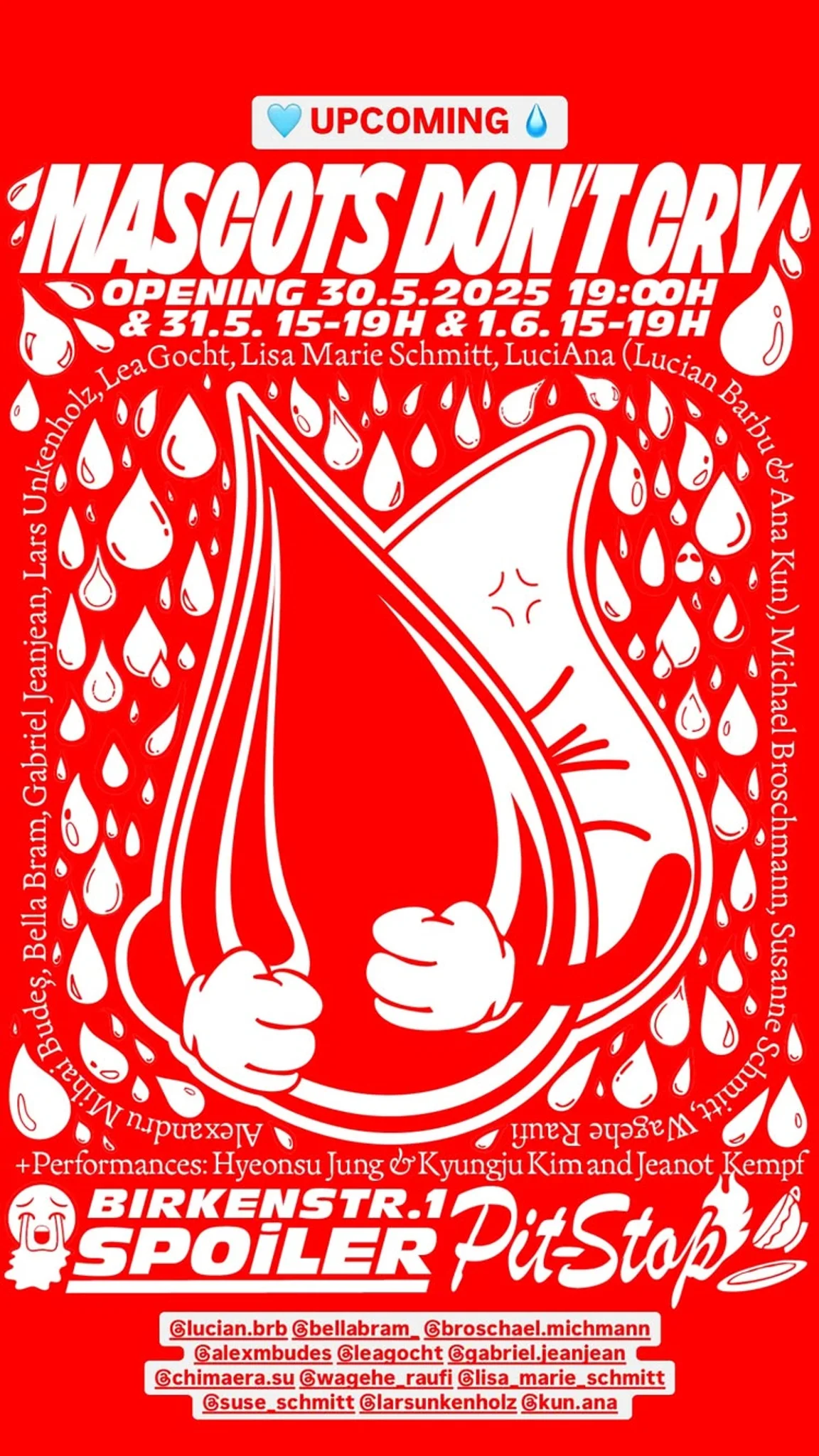
Eröffnung: 30.05.2025 / 30.05.-01.06.2025 Alexandru Mihai Budeș, Bella Bram, Gabriel Jeanjean, Lars
Unkenholz, Lea Gocht, Lisa Marie Schmitt, LuciAna (Lucian Barbu & Ana Kun), Michael Broschmann,
Susanne Schmitt, Wagehe Raufi
mit Performances von Hyeonsu Jung & Kyungju Kim, Jeanot Kempf am 30.05.2025
Der unscharfe Blick schweift über den Boden, bleibt hier und da an einer Zigarettenkippe oder einem
Bonbonpapierchen hängen. Dort ist eine Pfütze, etwas Klebriges - vielleicht Eistee oder Cola. Darin
schwimmt ein Kaugummi, die Zahnabdrücke sind noch deutlich erkennbar. Zusammen mit zwei
schaumigen Blasen des Sirupgetränks scheint plötzlich ein Gesicht zurückzugrinsen; kurzes Aufschrecken
vor überraschend Nahem, scheinbar Bekanntem. Pareidolische Projektion suggeriert Vertrauen, oder für
einen Moment das Gefühl einer Verbindung, bis sich die Einheit ‘Gesicht’ wieder in Einzelteile auflöst.
Wieder durch kognitive Mustererkennung die Sinne getäuscht; enttäuscht, dass das Gesicht nur durch dich
kam; dass das Vertraute du selbst warst – gerade noch eine Verbindung nach Außen aufgebaut, scheint nun
alles wieder Innenwelt.
Kurz das Eigene vergessen, wirkt die Vorstellung einer anderen Subjektivität nach – jene flüchtigen
Momente emotionaler Identifikation, getragen von einem skizzenhaften Projektionsspielraum aus
narrativen und figurativen Nudges. Von Maskottchen bis Werbefiguren ist es schwer, die Lockrufe
kichernder Gummischlümpfe im Plastikeimer oder Liebesbotschaften, die auf Schokoladenglasurkeksen in
kursiv eingeprägter Schrift
Je t'aime hauchen, zu ignorieren.
Die Faszination hält sich besonders, solange die Figuren sich nicht vollständig erklären und in eigenen
Logiken aufgehen. Vertraut genug, aber anders, nicht ganz passend: „Weird“. Etymologisch ist der Begriff
eng verknüpft mit Verweisen auf Schicksal, dem Übernatürlichen oder Unheimlichen, also einer
unbekannten Handlungsfähigkeit. Erst innerhalb der letzten zwei Jahrhunderte wurde der Begriff
zunehmend profaner, fokussierter auf das Seltsame oder Komische. Wie auch das deutsche Wort „werden“,
geht es auf die indogermanische Wurzel „wert-“ („drehen, wenden“) zurück. Heutzutage oft benutzt als
suggestive Taktik, macht das Weirde nämlich auch andere Logiken zugänglich oder verweist auf ihre
Möglichkeit.
Laut Mark Fishers
The Weird and the Eerie stört es dominante kognitive Muster und eröffnet damit auch
Denk- und Wahrnehmungsräume jenseits des Erwartbaren. Im Gegensatz zum rein Fantastischen oder
Märchenhaften verweist das Weirde nicht auf eine andere Welt, sondern stört diese Welt von innen heraus.
Das Seltsame wird durch eine Präsenz ausgelöst – die Anwesenheit dessen, was nicht dazugehört. Doch
auch das eskapistische Element des Märchens und Wunderbaren kann laut Literaturwissenschaftlerin
Marina Warner ein Katalysator für Widerstand und kritisches Denken sein. Die Märchenerzähler*innen derprécieuses im 17.Jhd nutzten Märchen als sprachliches Mittel der Emanzipation. Codiert in Märchenhaftem
entwarfen ihre Geschichten alternative Realitäten. „Wonderful“ kann demnach gleichermaßen als subversiv
und poetisch gesehen werden.
Die Positionierung und Schärfe der Grenzziehung zwischen Eigenem und Anderem, Innen- und
Außenwelt, Normen und Abweichungen scheinen in beiden Begriffen entscheidend dafür, inwieweit sie
Handlungsfähigkeit für Veränderungspotenzial bieten oder durch die klare Abgrenzung von Fiktion zu
Realität, Normen bestätigen oder wiederholen.
------------------------------
Opening:30.05.2025 / 30.05.-01.06.2025 Alexandru Mihai Budeș, Bella Bram, Gabriel Jeanjean, Lars
Unkenholz, Lea Gocht, Lisa Marie Schmitt, LuciAna (Lucian Barbu & Ana Kun), Michael Broschmann,
Susanne Schmitt, Wagehe Raufi
with Performances by Hyeonsu Jung & Kyungju Kim, Jeanot Kempf on May 30.2025
The blurry gaze is wandering across the floor, lingering here and there on a cigarette butt or a candy
wrapper. There is a puddle, something sticky - perhaps Ice Tea or Coke. A piece of chewing gum floats in
there, the teeth marks still clearly visible. Along with two frothy bubbles of the syrupy drink, a face suddenly
seems to grin back; a brief startling of something surprisingly close, seemingly familiar. Pareidolic projection
suggests trust, or for a moment the feeling of a connection, until the unit ‘face’ dissolves into individual
parts again. Again, the senses are deceived by cognitive pattern recognition; disappointed that the face only
came from the inside; that the familiar was you. Having just established a connection to the outside,
everything now seems to be an inner world again.
Briefly forgetting what is one's own, the idea of another subjectivity lingers - those fleeting moments of
emotional identification, carried by a sketchy projection of narrative and figurative nudges. From mascots to
advertising figures, it is difficult to ignore the lure of giggling gummy Smurfs in a plastic bucket or love
messages whispering
Je t'aime in italic letters on chocolate-coated cookies.
This fascination remains particularly strong as long as these characters are not completely self-explanatory
or unraveling in their own logic. Familiar enough, but different, not quite fitting: “Weird”. Etymologically,
the term is closely linked to references to fate, the supernatural or the uncanny, i.e. an unknown ability to
act. Only in the last two centuries the term has become increasingly profane, more focused on the strange
or odd. Like the German word “werden” (becoming), it goes back to the Indo-European root “wert-” (“to
turn”). Nowadays often used as a suggestive strategy, the “Weird” also makes other logics accessible or
points out their possibility.
According to Mark Fisher's
The Weird and the Eerie, the weird disrupts dominant cognitive patterns and
thus opens up spaces of thought and perception beyond the expected. In contrast to the purely fantastical
or fairytale-like, the weird does not refer to another world, but disrupts this world from within. The weird is
triggered by a presence - the presence of that which does not belong. However, according to literary scholar
Marina Warner, the escapist element of fairy tales and the “Wonderful” can also be a catalyst for resistance
and critical thinking. The storytellers of the
précieuses in the 17th century used fairy tales as a linguistic
means of emancipation. Coded in fairy tales, their stories created alternative realities. “Wonderful” can
therefore be seen as both subversive and poetic.
The positioning and sharpness of the demarcation between self and other, inner and outer world, norms
and deviations seem to be decisive in both concepts for the extent to which they offer the ability to act for
potential change or confirm or repeat norms through the clear demarcation between fiction and reality.